Stories Antarctica
Antarctica at the end of the season
No southern lights. Instead: whales at arm’s length, a storm over the Peninsula and 24 hours as the southernmost passenger ship on Earth.
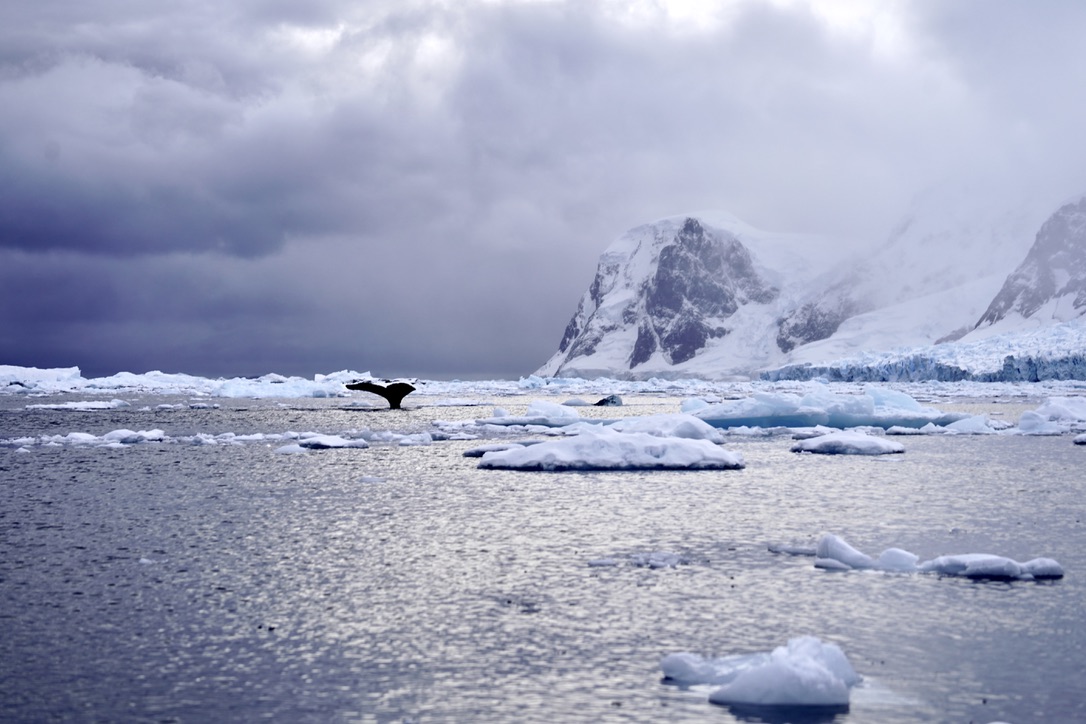
At the end of March 2026 I spent eleven nights on the Hondius, sailing from Ushuaia on a voyage with a promise in its name: Beyond the Polar Circle. It was planned around the southern lights, with an astronomer on board, long nights and little moon. We never saw them. Not once.
What we got instead: extraordinary wildlife, weather that kept everyone guessing, and twenty-four hours as the southernmost passenger ship on Earth.
The ship was made for it. The Hondius is 107 metres long, carries 170 passengers in 80 cabins, and was the first ship in the world registered to Polar Class 6, built from the keel up for expedition cruising rather than converted from something else.
The Drake shake
Between the Beagle Channel and the first iceberg lie two days of open water. The Drake Passage is the 800-kilometre gap between Cape Horn and the South Shetland Islands, and the Antarctic Circumpolar Current pours through it without a single landmass in the way. That is why the swell builds the way it does, and why every Antarctic traveller learns two names on day one: the Drake Lake, if you're lucky, and the Drake shake, if you're us.
Somewhere in the middle we crossed the Antarctic Convergence, the line where cold Antarctic water meets the warmer water from the north and sinks beneath it. You can't see it, but the ship's instruments can: the sea temperature drops by a few degrees within hours, and the air follows.
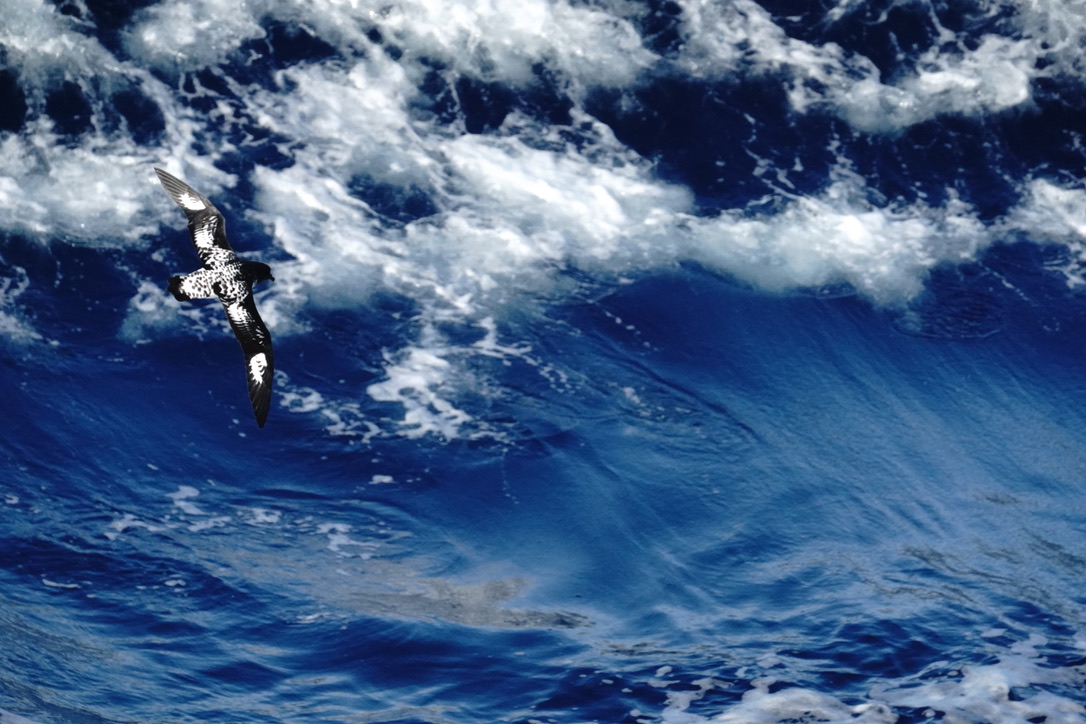
The reward for staying on deck was the birds. Cape petrels, speckled black and white across the back, which is why they are also called pintado petrels, worked the wind behind the ship hour after hour. They have followed ships down here for as long as there have been ships; the old sailors called them Cape pigeons.
Late season is expedition season
March is the end of the Antarctic summer, and it feels different from the postcard version. The days are shorter, the light turns golden early, and fewer ships are out. The wildlife is at its busiest: humpbacks feed hard on krill before they migrate north, the penguin chicks are fledging, and leopard seals patrol the ice edge, waiting for them.
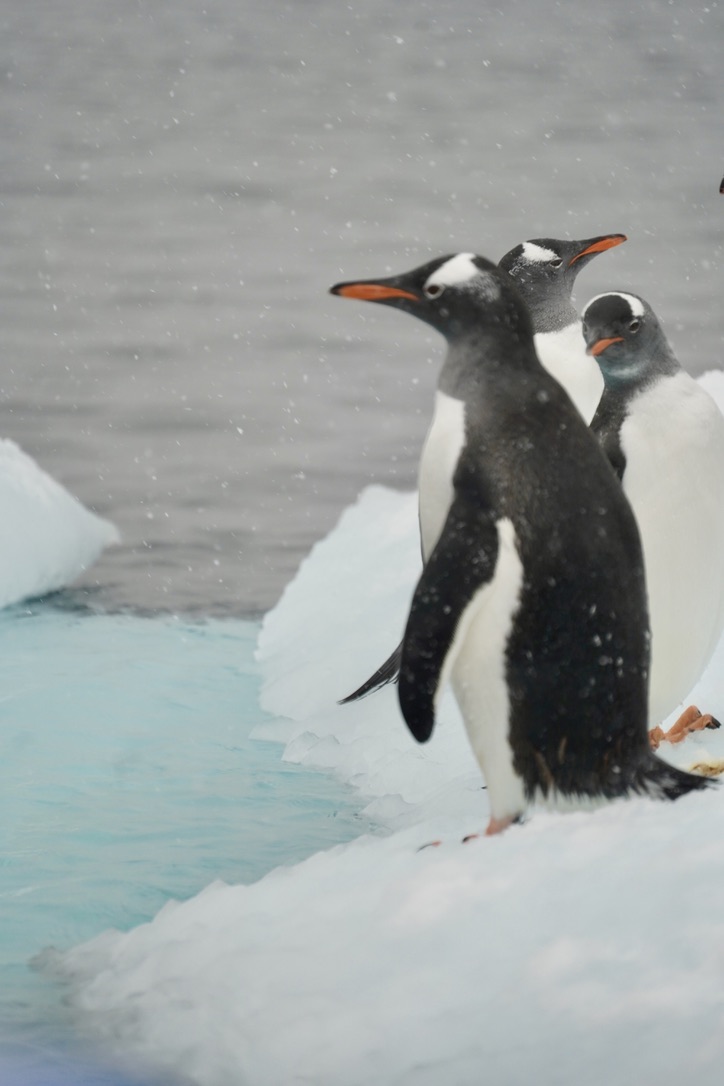
Our first day on the Peninsula took us to Neko Harbour, a landing on the continent itself rather than on an island. The gentoos there nest on the hill above the beach for a reason: the glacier across the inlet calves so often that its waves wash over the shore. The birds are easy to name, with the white stripe across the top of the head, like a bonnet, and the orange-red bill that belong to no other penguin. They are the third-largest penguin species and the fastest swimmers of them all, up to 36 km/h underwater. Their chicks go to sea at 80 to 100 days old; by March the season's young are on their way out.
The weather is busier too. A storm came over the Peninsula while we were there, and the expedition team rebuilt the plan around it, morning by morning. It felt less like a cruise and more like an expedition, which for me was the point.
In Antarctica, the itinerary is a list of hopes, not promises.
Whales at arm's length
The humpbacks were the headline, and they started on day one in Wilhelmina Bay, which the guides call Whale-mina Bay. Researchers once counted more than five humpbacks per square kilometre here, feeding on a super-swarm of krill; in late autumn the whales eat as much as they can before the winter. One dived in front of a glacier just as the storm arrived; another, days later, surfaced beside one of the Zodiacs, close enough to count the barnacles on its head. Those white knobs are acorn barnacles, Coronula diadema, and they settle on the tip of the lower jaw and along the grooves of the throat, where the water flows past them all day.
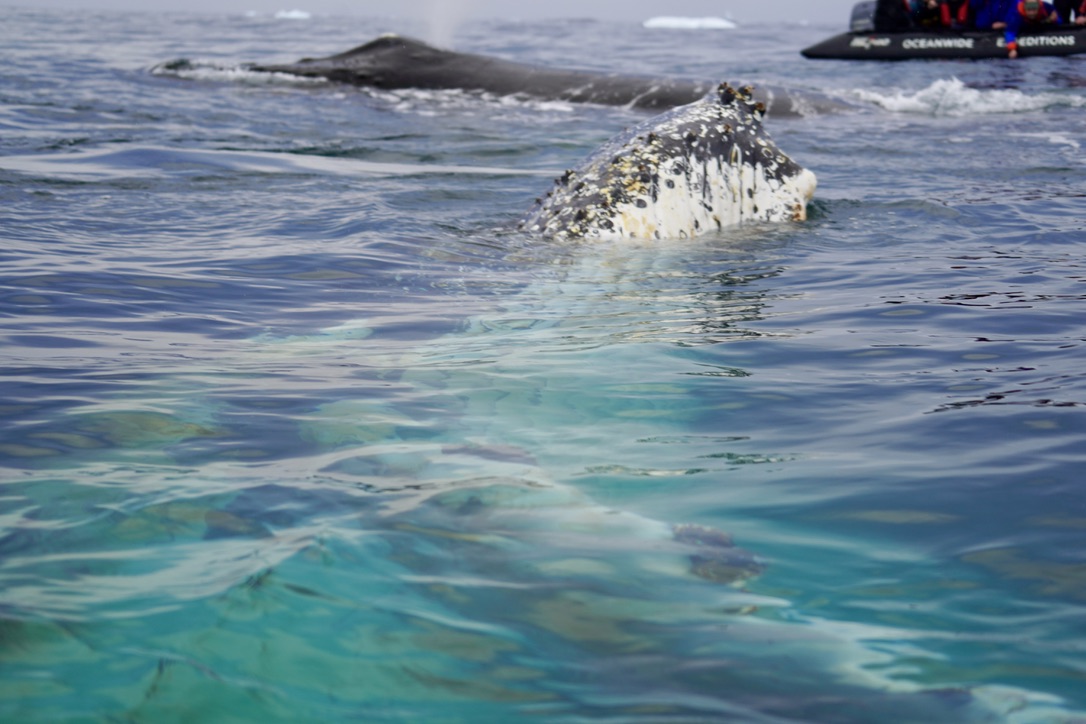
The whales are here for one reason: Antarctic krill. The west coast of the Peninsula is one of the great humpback feeding grounds, and in late summer they feed hard. By April most of them are gone, on a migration of up to 8,000 kilometres to the warm breeding waters off Brazil.
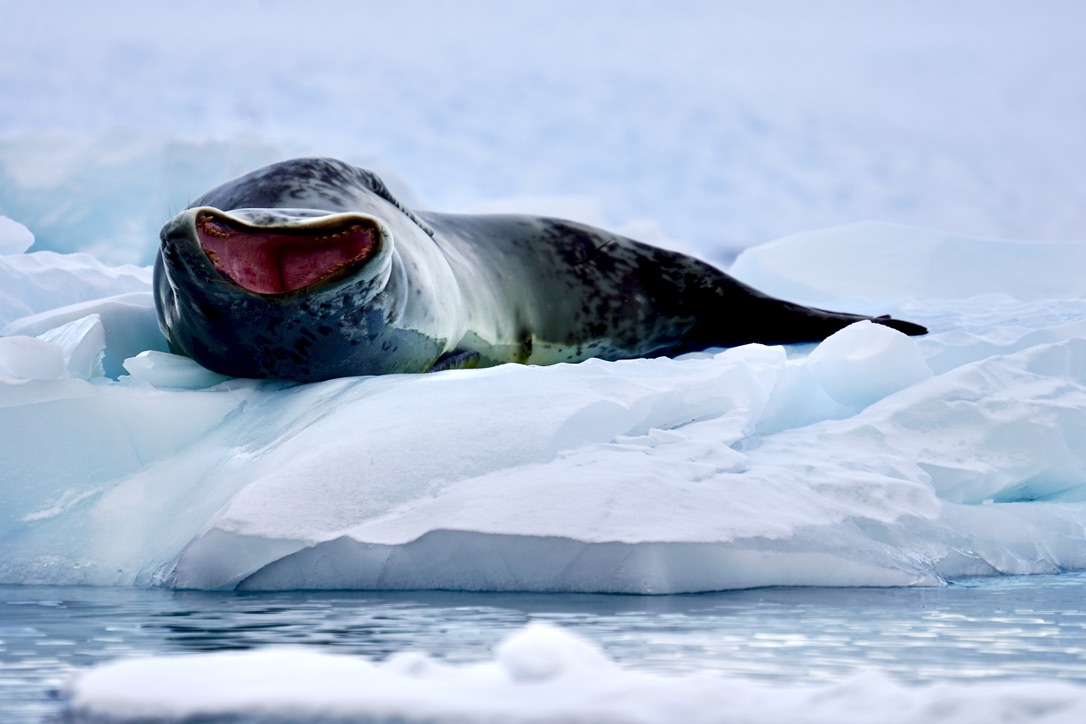
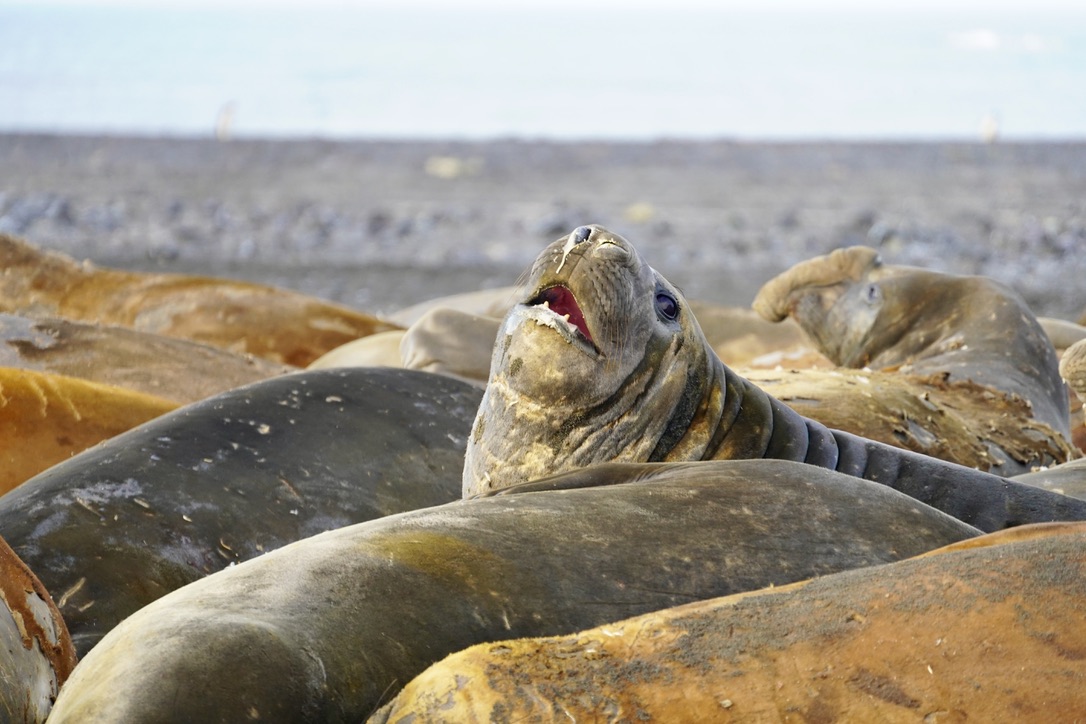
Add a leopard seal yawning at us from its floe, all teeth, and elephant seals piled on a beach like driftwood, and March made its case. The leopard seal is the second-largest seal in Antarctica, up to 3.5 metres and 600 kilograms, and it hunts penguins by lying almost submerged at the edge of the ice, waiting for them to jump in. The elephant seals we met on our last morning, at Elephant Point on Livingston Island, a headland named after them. They are the largest seals on Earth; a bull can reach almost six metres and weigh more than three tonnes. In summer they come ashore to moult, and while the old skin comes off in sheets they lie packed together on the beach and barely move.
Twenty-four hours at the bottom of the map
From Neko Harbour the ship ran south for a full day, down the coast past the Fish Islands and Lavoisier Island, and on 24 March crossed the Antarctic Circle, 66°33′ south, in Crystal Sound. It kept going through the night: past Detaille Island, through The Gullet, the narrow channel between Adelaide Island and the mainland that the ice closes more often than not, and into Marguerite Bay. On the morning of 25 March we went ashore on Stonington Island, 68°11′ south. For twenty-four hours the Hondius was the southernmost passenger ship in the world.
That is rarer than it sounds. In the 2023–24 season IAATO counted 536 voyages that landed passengers on the Peninsula. Ships put people ashore at Neko Harbour, the busiest site, 193 times. At Detaille Island, beyond the Circle: 44 times, all season. Marguerite Bay is further still.
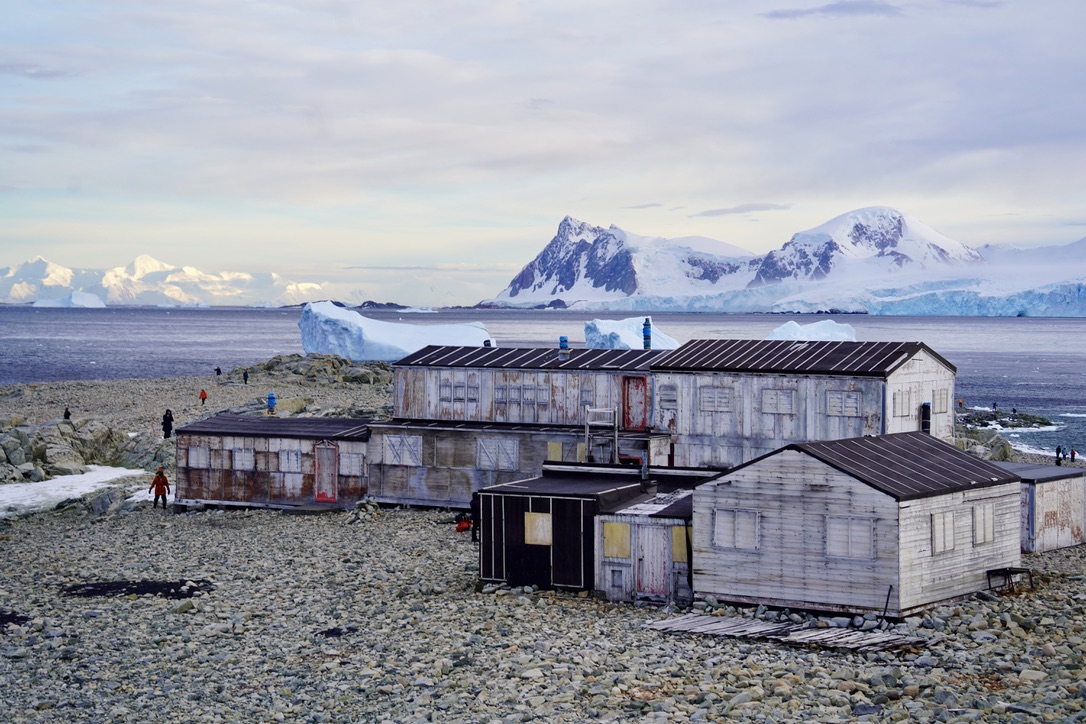
Stonington Island is where two countries kept house at the end of the world. The Americans built East Base here in 1939, the first United States research station in Antarctica, and named the island after Stonington, Connecticut, the home port of the sloop in which Nathaniel Palmer sighted the continent in 1820. The British followed with Base E in 1946 and stayed, on and off, until February 1975. Both are protected historic sites today, and on a calm morning you can walk from one to the other in minutes.
The huts are still standing: wooden walls weathered grey, boarded-up windows, and icebergs grounded in the bay behind them. Base E's main building, Trepassey House, was cleaned up and repaired in 1992, and the two stations are Historic Sites and Monuments 55 and 64 under the Antarctic Treaty. Behind them the ice front of the Northeast Glacier fills the horizon.
On the way back north we went ashore at Detaille Island, where Britain ran another base, W, for just three winters. In the autumn of 1959 the sea ice was so heavy that the relief ship could not get through; the men loaded their sledges with the most valuable gear, drove the dog teams out across the ice to the ship, and never came back. The hut with its boarded-up windows, the emergency store, the dog pens and the radio masts are all still there, Historic Site number 83 since 2009.
Night in the ice
We did go looking for the aurora, and the timing was no accident. The geomagnetic storms that light up the polar sky come nearly twice as often around the equinoxes as in midsummer, a pattern geophysicists have known since the 1970s. A voyage over the March equinox, with long nights and little moon, is as good a bet as Antarctica offers.
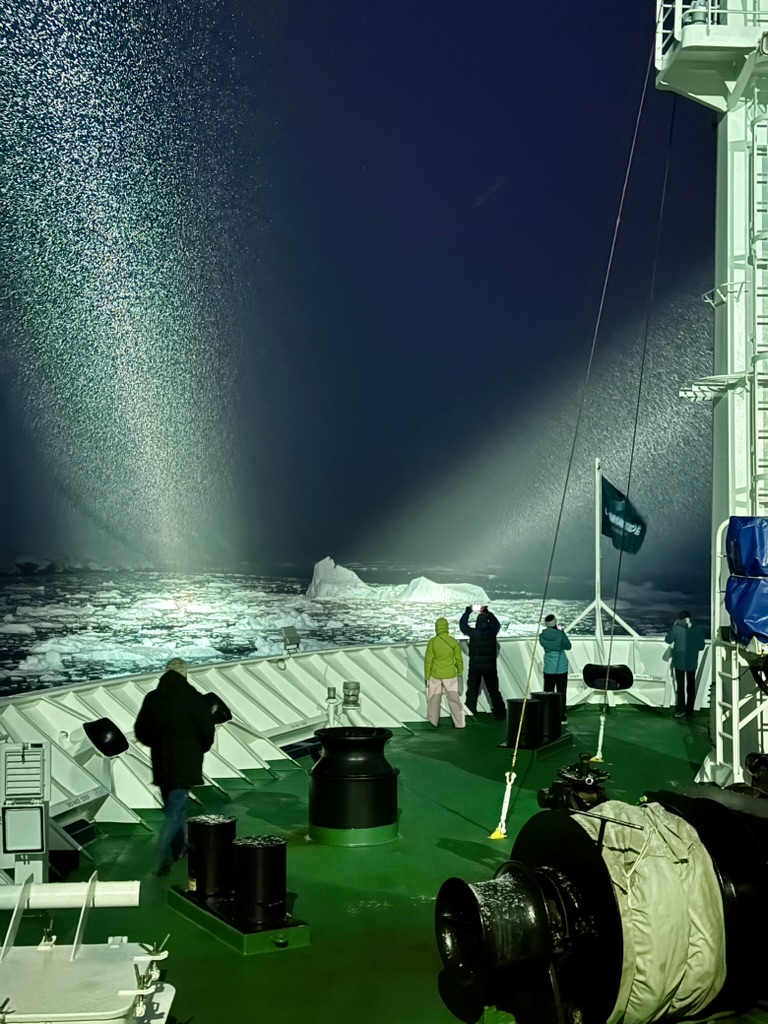
On the evening of 26 March, near the Lemaire Channel, the bow was the place to be: the searchlight sweeping the pack ice, snow drifting through the beam, a handful of us out in the dark. No southern lights. Just the ship, the ice and that light.
The Lemaire Channel itself is eleven kilometres long and 600 metres wide at its narrowest, a slot between the cliffs of Booth Island and the mainland so photogenic that expedition crews call it Kodak Gap. The first ship through it was the Belgica, in December 1898, on the Belgian expedition that went on to spend the first winter anyone had spent in the Antarctic.
Wrecks, moss and a warm-blooded volcano
The last Peninsula day was for the north. At Foyn Harbour the burnt-out hull of the Governoren still lies where its captain ran it aground in January 1915: a Norwegian whaling factory ship, full of whale oil, that caught fire during the end-of-season party; all 85 men got off. At Cierva Point, a few miles on, Argentina's summer-only Primavera Base sits in one of the greenest corners of Antarctica, a protected area of moss, lichen and the continent's two flowering plants.
Then two more stops in the South Shetlands. Elephant Point on Livingston Island, for the seals. And Deception Island, a flooded volcano: you sail into its crater through Neptune's Bellows, a gap barely 500 metres wide, and anchor inside the caldera. The volcano is not finished. Eruptions in 1967 and 1969 wrecked the British and Chilean research stations here, and the island was abandoned for years afterwards; today only two summer-only bases remain, one Spanish and one Argentine.
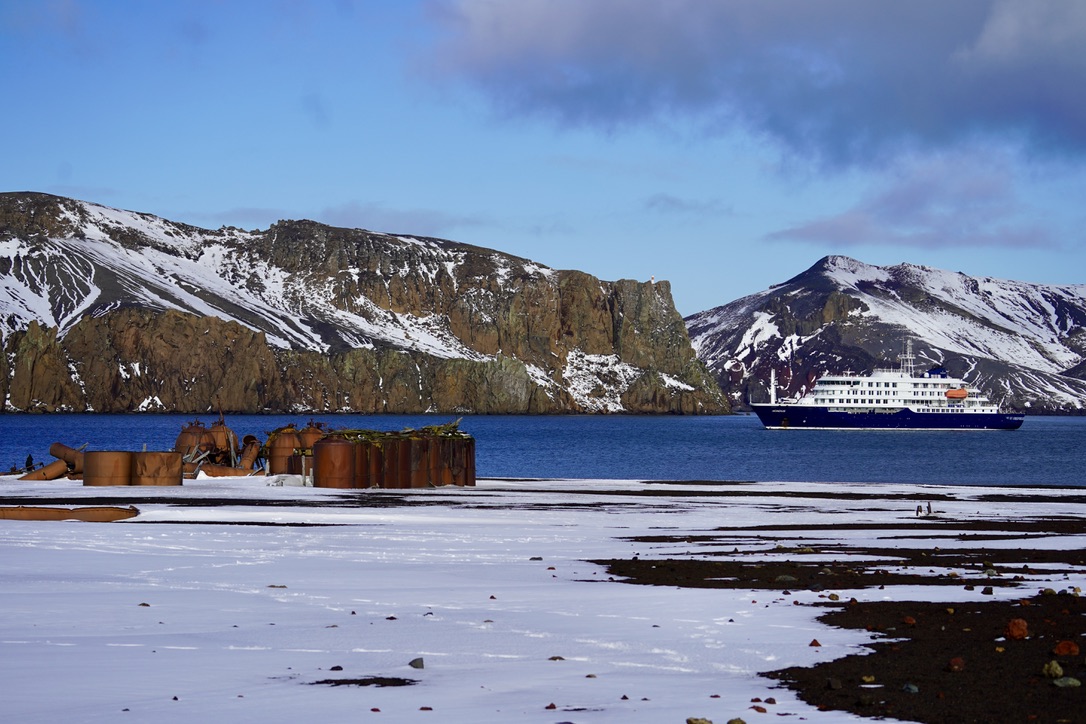
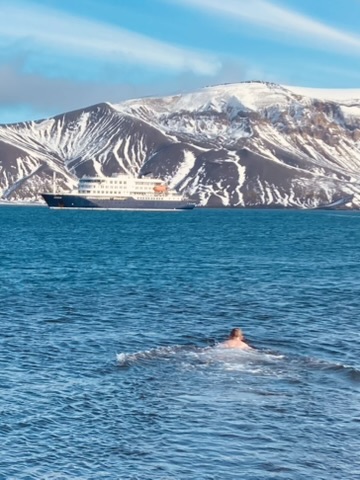
At Whalers Bay, the old whaling station still rusts on the black sand. Norwegian whalers worked this bay from 1906, and from 1912 the Hektor company ran a shore factory here; the tanks you can still walk around are what is left of it. It closed in 1931, and with it commercial whaling on the island. And then the polar plunge: from the black sand straight into the caldera, with the Hondius at anchor behind. The volcano warms the beach and the shallows in places, which is why so many ships pick this bay for it. Nobody stays in long. Then two more days on the Drake, and Ushuaia.
If you're thinking about March
- What about the weather? Storms and the Drake set the plan, and the captain has the final word.
- What wildlife will you see? Whales feeding before their migration, fledging penguin chicks, leopard seals on the ice.
- How cold and dark is it? March averages around −2 °C (28 °F), and the nights are long. That is what gives the aurora a chance.
- Do you need swimwear? The polar plunge at Deception Island is voluntary, and everyone does it.
- What insurance do you need? Oceanwide requires emergency evacuation and medical cover for Antarctica.
- When should you arrive in Ushuaia? Give yourself a night or two in Ushuaia before boarding: flights to the end of the world run late more often than ships wait, and the town is worth the days.
The route we actually sailed
Our voyage: "Antarctica – Beyond the Polar Circle", a Betchart Expeditions and Planetary Society charter on Oceanwide Expeditions' Hondius, 20–31 March 2026. The brochure lists hopes; this is what the ice and the weather allowed, copied from the chart the expedition team drew up as we went. Nine stops, one crossing of the Circle, and a turn-around 400 kilometres south of it. The map is our own sketch: the stops are placed approximately, spread out so the names can be read, and the line between them is the idea of the route, not the ship's track.
- Day 1Ushuaia20 March · board in the afternoon, sail the Beagle Channel
- Days 2–3Drake Passage21–22 March · open ocean, the Antarctic Convergence, cape petrels
- Day 41 · Wilhelmina Bay23 March · Zodiac cruise among feeding humpbacks
- Day 42 · Neko Harbour23 March · first landing on the continent: gentoos in the snow, the calving glacier
- Day 5Across the Antarctic Circle24 March · south past the Fish Islands and Lavoisier Island, over 66°33′ S in Crystal Sound, on through The Gullet
- Day 63 · Stonington Island25 March · morning ashore in Marguerite Bay; 68°11′ S, the southernmost point: East Base and Base E
- Day 64 · Detaille Island25 March · ashore at Base W on the way back north, then across the Circle
- Day 75 · Lemaire Channel26 March · a humpback beside the Zodiac; the night in the ice
- Day 86 · Foyn Harbour · 7 · Cierva Point27 March · the wreck of the Governoren; leopard seal on the ice; Primavera Base
- Day 98 · Elephant Point · 9 · Whalers Bay28 March · elephant seals on Livingston Island; Deception Island, the whaling station and the polar plunge
- Days 10–11Drake Passage29–30 March · northbound
- Day 12Ushuaia31 March · disembark
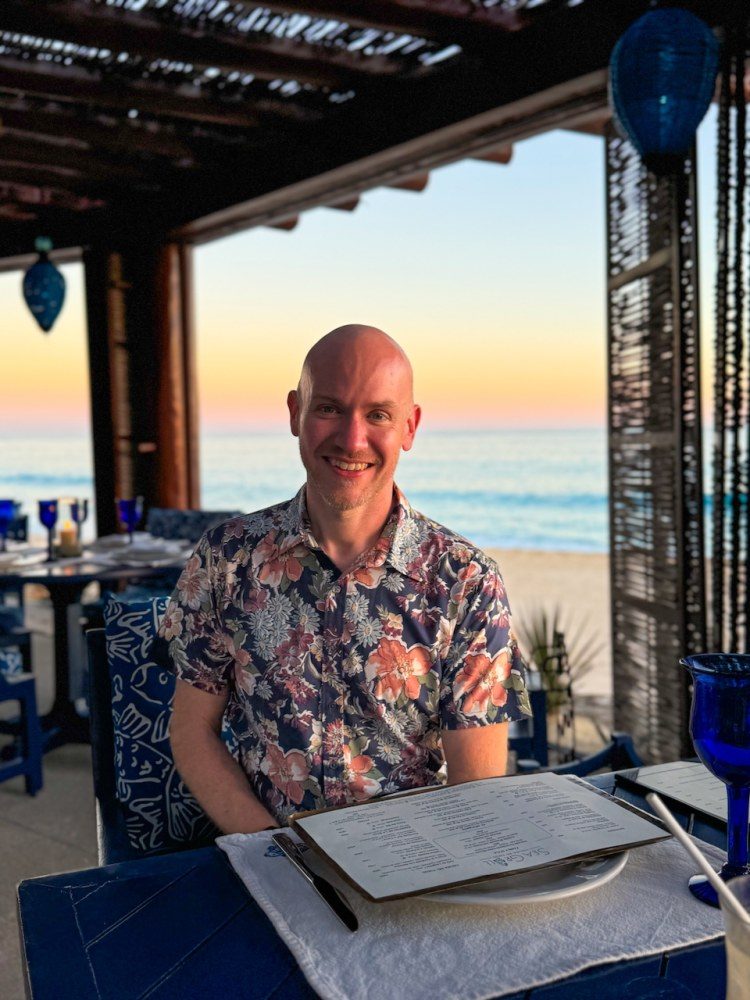
Jon can get you the best deals.
Jon Nickel-D’Andrea · Travel advisor with Fora Travel
Tell Jon you read this story. He builds the same trip around your dates, your pace and the people you’re travelling with.
Easy to add yourself, whoever books the trip.
If you book through an affiliate link, yourwindowseat may earn a commission, at no extra cost to you. How we earn
What to book yourself, and what to leave to Jon →